
Luck as a Character: How Game Studios Turn Abstract Concepts Into Iconic Visual Heroes
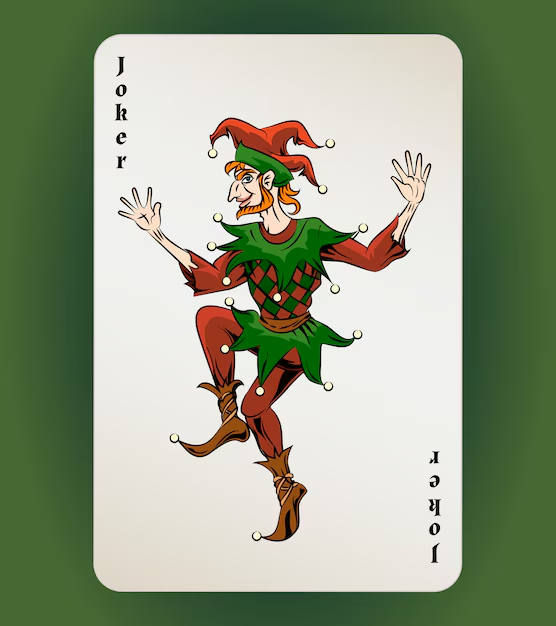
The ancient Romans personified luck as Fortuna – a blindfolded woman with a wheel and a cornucopia, dispensing fortune without favouritism. The medieval world inherited her, adjusted her wardrobe, debated her theology. Every culture that has ever grappled seriously with randomness has ended up, sooner or later, giving it a face. Not because randomness needs a face to function, but because humans need a face to feel. Abstract forces become memorable only when they acquire personality, and personality requires a body.
Game studios have been working this same territory for decades, and the results range from forgettable to genuinely iconic. The joker figure is the one that keeps coming back – and the reason isn’t arbitrary. Players who’ve spent time with joker-themed formats tend to develop a loyalty that goes beyond surface aesthetics, and when you look at what titles like lucky joker slot do well, the answer is usually the same thing: the visual character and the emotional logic of play are genuinely aligned. The grinning, unpredictable trickster figure doubles as a perfect metaphor for what a bonus round actually feels like. That coherence between mascot and mechanic is rarer than it sounds.

The problem with designing luck
Luck is genuinely difficult to visualise. Unlike strength or speed, which have obvious physical correlates, luck has no body. It exists only in retrospect – you recognise it after it has happened, never while it’s arriving. Designers who try to represent luck literally tend to produce either clichés (horseshoes, four-leaf clovers, rabbits’ feet) or visual noise: a shower of coins and sparkles that communicates excitement without meaning.
The smarter approach is indirect. Instead of showing luck, you show its agent – a character who embodies the quality, whose visual personality expresses it without defining it. This is what the joker archetype does. The playing card joker is already a figure of structured ambiguity: neither high nor low card, capable of being either, defined by its exception status. The visual language writes itself from there.
| Luck archetype | Visual strategy | Emotional tone | Design risk |
| Classical (horseshoe, clover) | Object-based | Nostalgic, familiar | Becomes invisible quickly |
| Divine figure (fortune goddess) | Character-based | Awe, distance | Hard to make accessible |
| Trickster / joker | Character-based | Playful, unpredictable | Can feel threatening |
| Abstract (sparkles, light) | Effect-based | Excitement, energy | Shallow, exhausts fast |
What makes a trickster work as a mascot
The trickster figure has a long anthropological history. Loki in Norse mythology, Anansi in West African tradition, Coyote in various Native American stories – the trickster appears across cultures as the entity that operates outside the rules precisely in order to reveal what the rules actually are. The trickster isn’t malevolent; it’s liminal. It lives at the boundary between order and chaos and makes both more legible by crossing between them.
For a game mascot, this is almost perfect conceptual alignment. The player is also operating at a boundary – investing something real in exchange for an outcome that’s genuinely uncertain. The trickster figure acknowledges this tension directly. It doesn’t promise good outcomes; it promises interesting ones. And interesting is, it turns out, exactly what players are willing to pay for.
The craft of turning archetype into asset
A successful mascot does something that good branding always does: it creates a shorthand. Once a visual identity is established strongly enough, players complete the message themselves. The hat, the bells, the exaggerated grin – these stop being design choices and start being a language. Players who’ve seen the figure a hundred times respond to it before they’ve read a single word of accompanying text.
This is what separates the joker archetype’s longevity from simpler luck symbols. A horseshoe carries one meaning and it’s immediately exhausted. The joker carries several meanings in tension – wit and recklessness, insight and chaos, the insider’s knowledge and the outsider’s freedom – and those tensions are never fully resolved. Every encounter with the image opens up slightly differently depending on what mood the player brings to it.
Studios that understand this build their visual systems to sustain the tension rather than resolve it. The grin stays ambiguous. The costume stays theatrical without tipping into menace. The colour palette – usually high-contrast, usually warm – signals energy without specifying what kind. The result is a mascot that functions like a good character in a novel: the more you look at it, the more it looks back. That quality is impossible to achieve with an object. A horseshoe doesn’t have opinions. A joker always seems to.
Visit our website for more.